Despite suffering a spinal cord injury at a very young age, Bongani Mapumulo has thrived with some wisdom and lessons learned
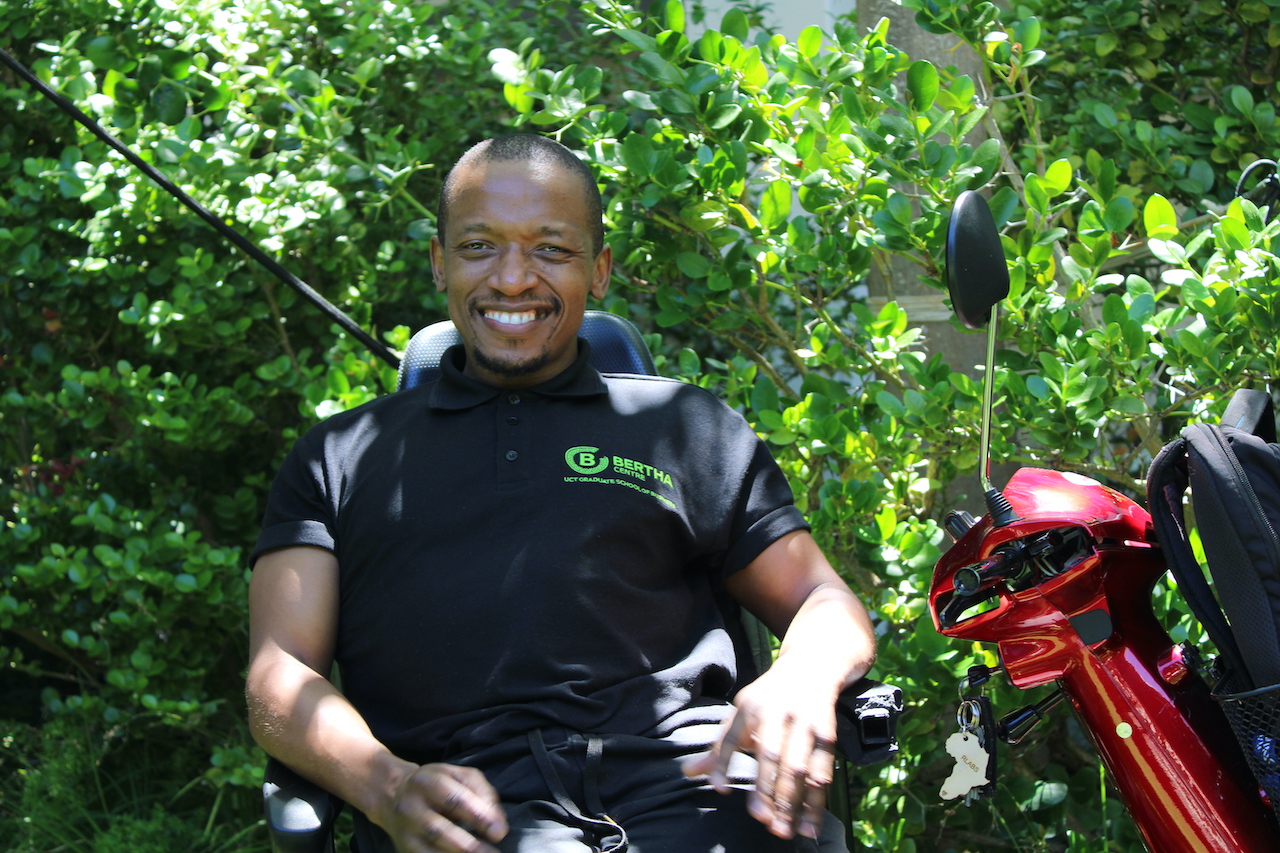
In his bright red scooter, Bongani Mapumulo rides down the halls of the University of Cape Town Graduate School of Business where he is currently completing his Masters of Philosophy specialising in Inclusive Innovation with a research focus on assistive technologies for people with disabilities.
He is stopped often as staff and students alike greet him. It seems he knows everyone, and everyone knows him. It’s unsurprising as Bongani is charming and vibrant with an infectious, bolstering laugh. With his shining optimism, it is easy to think that Bongani must have a simple, easy life. Yet, this couldn’t be further from the truth. Rather, Bongani has been able to transform hardships into drive and passion.
Early life
At age five, a gunshot wound caused Bongani to become paraplegic. At the recommendation of hospital staff, he was sent to boarding school at Ethembeni School in Cato Ridge, Durban. While it was challenging to be away from home at such a young age, Bongani also believes this small choice, made a big difference in his future.
“The social workers said it’s probably going to be better if they put me into a special school for further rehab and to meet other kids who are in a similar situation like me,” Bongani recalls. “I would say it was one of the most prominent decisions. Obviously, I hated the idea at the time. At five years old, you just want to be at home with your parents and siblings.”
“But I think it was all about looking into the future: What seems like discomfort now is going to be valuable later,” he added. While the teacher were strict and demanded discipline, they were also very encouraging.
“I think being in that school was really important to understanding myself in relation to other kids and, to still believe that there is a bigger world out there that we as kids with disabilities are still going to integrate into. I remember we would still have questions such as, ‘What do you want to be when you grow up?’”.
Aside from the teachers, Bongani believes his parents played an important role in instilling confidence in him: “For me, a big role was played by my father, who unfortunately passed. He said, ‘To succeed, to be something in life, you’re actually not going to need your legs’. I think it was so profound. It applies to other parts of life.”
Bongani took this encouragement seriously. He completed his schooling at Open Air School in Glenwood, Durban, where he was part of an accelerated development programme run by Standard Bank at the school. When he graduated, he started working at the bank. Several years later, he started considering what else life might have to offer him.
“I always had these thoughts like, ‘What am I missing? Did I skip a step? There’s a bigger world out there and I would like to explore it’,” he shares.
This led him to the Stellenbosch University where he obtained his undergraduate degree majoring in sociology, anthropology and politics. Both his undergraduate and now his master’s degrees were made possible through donors.
During his time at Maties, he served as head of Dis-Maties – a student organisation supporting students with disabilities. Here he would learn to be an advocate for the rights of people with disabilities. Believing a future is possible, is half the battle. Then it becomes important to cultivate independence while still nurturing important relationships.
Cultivating independence
For people with disabilities, independence is crucial to practicing their own agency. Bongani shares his thoughts: “From what I’ve observed, in my own life, but more with other people, there’s a lot of exploitation that comes with being dependent on others. You end up living someone else’s life.”
“If you are in the unfortunate position of losing the use of your limbs, I think it’s critical to try and develop as many other parts of the self to be independent and self-reliant. There’s just so many benefits that come with being able to figure yourself out,” he adds.
By better understanding yourself, you are better able to advocate for yourself, learn your talents and limits, and invite others into your experience. However, this can be a life- long journey as Bongani notes: “It’s taken years and I think it’s still an ongoing process. I don’t think it ever gets to a point where it stops.”
“Unfortunately, if you have a disability, it’s probably going to take a lot to develop it and get to a point where you’re actually independent,” he adds. Independence and self-knowledge can also go a long way to building important relationships.
Relationships and allies
With a better understanding of self, people can better communicate their needs to loved-ones, their employer or donors. More importantly, close relationships can help create more allies to advocate on behalf of people with disabilities.
“I think if someone gets to know me personally and we are going somewhere, they get to see how the inaccessibility of spaces affects me; that makes it personal for them now. I think the more relationships like that, the more other people can take that burden off of us,” Bongani shares.
“I understand that for some people building relationships is daunting. We all have different personality types. But if we are somehow able to bring other people into our world, they can get to understand [the challenges of disability],” he adds. These relationships expand into communities that can empower and shape world views.
Community and leadership
Recalling how he became part of Dis-Maties, Bongani shares: “As I’m going through all the access-related challenges of starting out as a university student, I came across the student society for students with disabilities that basically exists to do a lot of advocacy work. Naturally, you want to join people where you don’t have to explain yourself.”
“I think it’s wanting to be part of a community. I’ve grown to understand that communities are very important. They all serve a particular purpose in how I approach my work and how I make sense of the world,” he adds. Communities can be networks to further yourself, but also provide an opportunity to help others – no matter how small.
His position with Dis-Maties, his activism work through the organisation, and later his position in residence leadership, taught Bongani how small, meaningful acts can be very important.
“I came to understand that there are different types of leadership. You can do the little bit that means the most to you; not biting off more than you can chew. It’s also way more meaningful to think, ‘How do I take this little thing and make it relevant and practical to these few people’,” he shares.
“How do I leave the space slightly better than how I found it? To me that means trying not to overburden myself when the change or the transformation I want is not happening at the pace that I want. I understand that maybe I’m meant to just play a small role in the greater scheme of things. That little does add to the momentum,” he continues.
Doing your bit for your community doesn’t have to result in formal activism. In fact, Bongani cautions those who are interested.
“I don’t think we all have the stomach for it. It can take a lot out of you. You might find yourself having to explain yourself a lot. Sometimes you explain yourself to people who will still don’t get you. You might have to ask yourself the tough questions of, ‘Do I still want to be part of this space despite not being received well or being misunderstood?’,” he shares.
“It’s a tight rope, because we all yearn to be relevant in not just our work, but to other people, especially in terms of wanting to be treated with respect,” he adds.
Facing a challenge
Regardless of what role you find yourself playing within your community, it is important to bravely step into the unknown.
“When confronting difficult things that might scare you, you tend to learn a little bit more about yourself. Think of it as a furnace that, if you’re able to manage or tolerate in a way, you can reap the benefits on the other side. I think, with most people, it looks so huge, intimidating and tough to tackle that they just don’t take it on at all,” Bongani shares his wisdom.
“I think it was also a valuable lesson to say you don’t know when you might be forced to restart. I think it’s what gave me the courage to say, ‘I feel like there’s a bigger world and a bigger calling for me, calling somewhere’. You never know when you might be forced to reset,” he adds.
Along with being ready for any curveball that life might throw at you, Bongani also encourages patience for when you are unsure.
“I might have no answers for the present, but if I venture into it intentionally, wilfully and honestly, I’ll get the answers over time. I just need to be patient; not just with myself, but with the world, because not everyone will always be understanding of what we are going through as individuals. Sometimes we just need to wait and the answers will come over time. I know it sounds easy to say, but it’s a lot harder to live out.”
With some patience, courage, independence and community, there can be many opportunities in this life – one that don’t require the use of legs.