Only people who rely on mobility aids that require additional space to enter and exit a vehicle should be allowed to use the “disabled” parking bays
Often, I’m asked who is allowed to park in a “disabled” bay. I want to answer this as clearly and accurately as possible. I hope that others will agree with this view, help spread the message and have the civic courage to call out those who abuse our facilities. I use the word “our” deliberately, because I am firmly convinced that so-called “disabled” bays exist for wheelchair users only.
Not for all disabilities
The term “disabled bay” is incorrect. These bays are designated specifically for wheelchair users and should be named accordingly. The current terminology creates confusion and invites misuse. Because they are labelled “disabled”, many people with disabilities – whose disability is unrelated to mobility or wheelchairs – feel entitled to park there. For some, it is seen as a compensatory benefit; a “perk” for the stigma or inconvenience of being labelled “disabled”.
The most frequent abusers of wheelchair parking bays are not the general public, but people with disabilities that don’t require wheelchair access. This includes individuals with minor mobility limitations, chronic aches and pains, respiratory conditions, limps, pacemakers, hip or knee replacements, frailty, amputations and visual impairments.
Of course, members of the general public contribute to the problem; those who are “just going to be two minutes”; “didn’t see the sign”, or are “in a rush”. The remaining offenders are simply indifferent. Unfortunately, this group is characterised by a complete lack of moral responsibility and social conscience. Reaching their sense of empathy or accountability is, regrettably, unlikely.
Legal requirements
The South African National Building Regulations and Building Standards Act (Act 103 of 1977) sets out the legal requirements for erecting buildings. To help businesses comply with the requirements, rules are published as the South African National Standard (SANS) 10400.
These rules regulate the accommodations for persons with disabilities such as accessible routes, ramp gradients, door width, toilet specifications, parking spaces and signage. Chapter 5.3 of the SANS 10400-S:2025 covers the parking regulations.
According to the Standards, one wheelchair accessible parking bay is required for every 25 standard bays. A large shopping centre with 501 to 1 000 bays requires two percent of the total number of bays to be wheelchair parking bays. More than 1 000 bays would require 20 plus one for each 100 over 1000 to be wheelchair parking bays.
If you are a wheelchair user, keep this information handy for when a facility does not comply with these numbers. You can argue with confidence should you want to engage the centre manager or developer.
True purpose of accessible bays
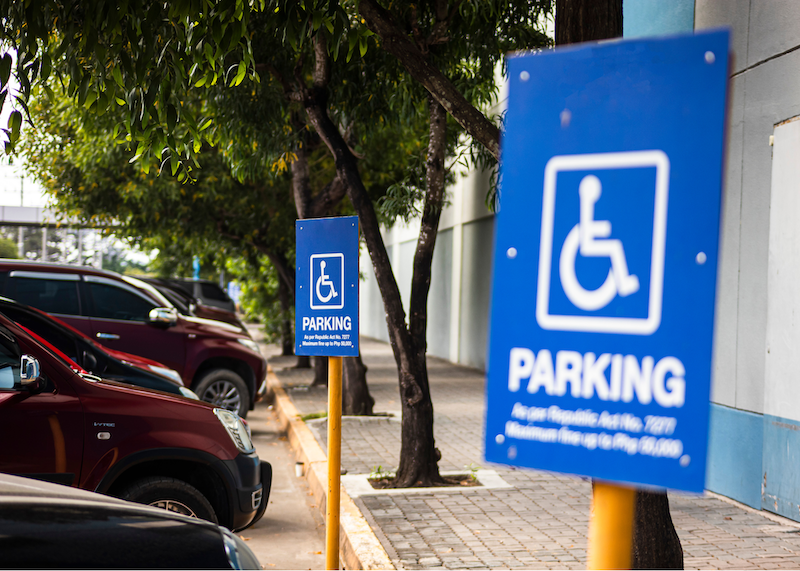
Most important is the size of a wheelchair parking bay. Depending on the version of SANS 10400 Part S, the minimum width of a wheelchair parking bay should be either 3 500 mm (2011 version) or 3 700 mm (2023 version) whereas a standard parking bay in 2 500 mm wide.
This width is critical to allowing a wheelchair user to safely enter or exit their vehicle. Without it, they cannot confidently stop and shop. A narrower bay simply won’t work. They either won’t be able to get out if there’s a car on either side or they won’t be able to get back in.
Wheelchair parking bays are traditionally placed near the entrances of facilities or shopping centres, which is where abuse often begins. The “abusers” park there not out of necessity, but for convenience. They enjoy a shorter walk, saving a few steps at the expense of a person who genuinely needs the space. Each bay misused significantly reduces the availability of accessible parking.
If you asked wheelchair users whether they would prefer a bay’s location over its width, most would choose width every time. They would rather wheel/push a little further than be unable to access a properly sized bay.
A common argument from non-wheelchair users is, “I can’t walk very far”. Yet, these same people will navigate the vast distances of a shopping centre, just to save 20 meters. Their reasoning doesn’t hold up when you consider the overall journey.
Enforcement lacking
The root of the problem lies in the law. The Road Traffic Act refers only to “disabled parking”, which leaves the interpretation open. Municipal bylaws often broaden the criteria even further.
In some Garden Route municipalities, for example, a doctor’s note certifying any bodily limitation, illness or disease is enough to qualify for a “disabled” parking disc. The result is a flood of people claiming access to wheelchair bays, leaving fewer spots for those who truly need them. Shame on those who take advantage!
The QuadPara Association of South Africa (QASA) supports the use of the wheelchair parking bays by individuals with other mobility impairments who truly need the additional space including people who use two crutches, a scooter, a Zimmer frame or similar mobility aids.
Still a privilege
I’m the first to acknowledge that the abuse of wheelchair parking is a relatively minor problem – especially in the wake of the unintended consequences of spinal cord injuries and severe disabilities, which can be life-threatening.
I also recognise that owning a vehicle and being able to drive, with the necessary adaptations, to a retailer or service provider of my choice is a privilege. Accessible public transport is virtually non-existent in rural areas – although I know that QASA is actively lobbying the Department of Transport to prioritise this.
Yet, this doesn’t mean this fight isn’t important. Wheelchair users should stand up for their rightful space! Show your civil courage and prevent these “abusers” from exposing their poor moral compass!