Team South Africa re-emerged on World Wheelchair Rugby stage with determination as the team builds towards the 2028 Paralympic Games
In October 2025, in the quiet Norwegian town of Skien, South African wheelchair rugby made a statement that echoed far beyond the walls of the Skien Fritidspark. After a decade away from international competition, the SA Wheelchair Rugby (SA WCR) National Paralympic Team returned to the global arena and did far more than simply participate. They dominated.
Over five matches, South Africa went unbeaten, clinching the 2025 World Wheelchair Rugby (WWR) European Division C Championship, securing promotion to Division B and re-establishing themselves as a serious force on the international wheelchair rugby landscape For athletes, coaches, and supporters alike, Norway was not just about medals. It was about belonging again.
A return years in the making
This campaign marked South Africa’s first international wheelchair rugby appearance since the 2015 Wheelchair Rugby World Challenge in London. That long absence was not due to a lack of talent or ambition, but structural, financial and logistical realities that stalled international participation.
The turning point came in 2025 when World Wheelchair Rugby rezoned South Africa from the Asia-Oceania Conference to Europe Division C. The move created a more practical competitive pathway in terms of travel, time zones and development progression, while reopening the door to Paralympic qualification routes. For SA WCR, Norway was about proving that the country still belonged in elite wheelchair rugby conversations.
Purposeful preparation
Team SA’s success in Skien was no accident. Preparation began months earlier under the leadership of national coach and High Performance Director Gary Burnard, whose background as a biokineticist shaped a structured, athlete-centred programme.
A national selection camp in February 2025 brought international expertise into the South African environment with input from respected World Wheelchair Rugby figures including Rob Tarr and Paralympic gold medallist Stuart Robinson.
From March onwards, the squad trained together weekly, complemented by three intensive national camps focused on conditioning, tactical systems and team cohesion. For a team returning after ten years, this level of preparation was essential. It rebuilt confidence, sharpened systems and ensured that when South Africa arrived in Norway, they arrived ready.
Experience meets new blood
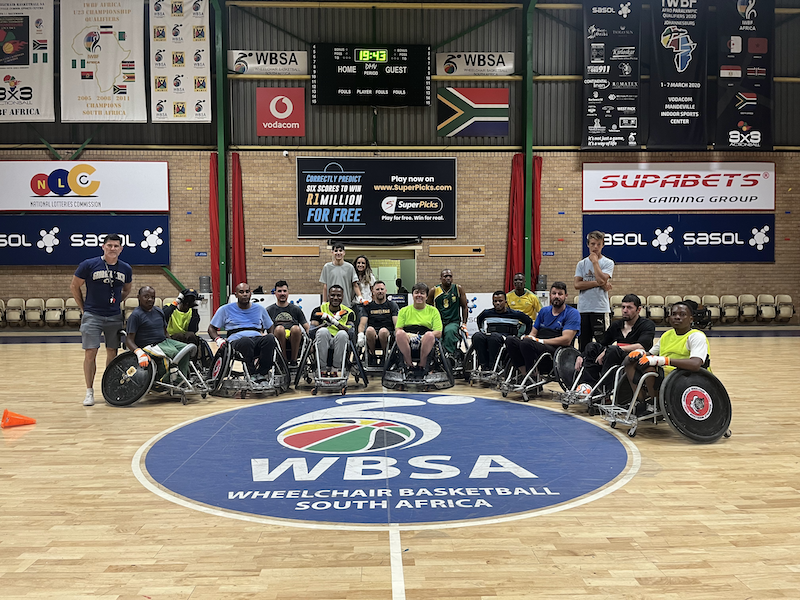
The final nine-player squad struck a careful balance between experience and debutants. Veterans such as Bennie Erasmus (captain), Bonga Khumalo, Clyde Holland, Lucas Sithole, Jared McIntyre and Okker Anker provided leadership and calm under pressure, while first-time internationals like Metz van Wyk, Morne Mulder and Jeffery Yates injected energy and hunger.
The newcomers adapted quickly to the pace of international play, while the capped players set standards on and off the court. The result was a squad that looked composed, connected and confident throughout the tournament.
Five matches with a clear message
The format of the Division C Championships was simple: Three teams, each playing the others twice, with the top two progressing to the final. South Africa wasted no time asserting control.
They opened with a commanding 70–22 win over hosts Norway, followed by a 61–32 victory against Ireland, their main rivals for the title. Two more dominant round-robin performances confirmed South Africa’s place in the final, where they again faced Ireland and delivered a decisive 62–29 win to seal the championship
Across all five matches, South Africa showcased tactical discipline, superior conditioning and an unmistakable hunger. They were faster on transition, clinical in attack and relentless in defence.
Individual shines in a team effort
While wheelchair rugby is defined by collective effort, individual excellence was rightly recognised in Skien. Captain Bennie Erasmus was named Best 1.0 Athlete of the Tournament, while Lucas Sithole and Okker Anker earned Best 3.0 and Best 3.5 honours respectively.
These accolades reflected not just personal performance, but the effectiveness of Team SA’s classification balance and on-court combinations. Every athlete understood their role, and every role mattered. For Erasmus, who had spoken before the tournament about believing the team could win Division C, lifting the trophy was both vindication and motivation.
More than a trophy
Beyond the scoreboard, the Norway campaign represented a critical milestone for disability sport in South Africa. Winning Division C secured promotion to Europe Division B in 2026, opening the door to competition against established nations such as Sweden, Poland, Italy and Spain.
Equally significant was the message sent to current and aspiring athletes at home. International success is possible. Pathways exist. Investment in preparation works. For a domestic league that has been rebuilding momentum post-Covid, seeing athletes return with silverware and confidence provides a powerful boost.
The road ahead
Norway was not the destination, but the foundation. Progressing through Division B and ultimately challenging for Division A status will require sustained support, deeper domestic structures and continued high-performance investment. Sponsorship, specialist support staff, and regular international exposure are now essential, not optional.
The pathway to the Los Angeles 2028 Paralympic Games is open, but it remains demanding. The European Division B Championships is the next stepping stone, taking place in Zaragoza, Spain, from 23 May to 1 June 2026. Norway proved that South Africa has the talent, the leadership and the systems to walk that path.
Rolling with confidence
In Skien, the SA WCR National Team did more than win a tournament. They reclaimed space on the international stage, restored belief within the local wheelchair rugby community and reminded the sporting world that South African disability sport belongs at the highest levels.
For Rolling Inspiration readers, this victory is a reminder of what happens when opportunity meets preparation. It is a story of athletes who refused to fade quietly, of a sport that rebuilt patiently, and of a team that roared back to life in green and gold.
South African wheelchair rugby is no longer knocking on the door. It has kicked it open.