The Cottle family embodies the true wonder of parental love as they continue to advocate and push for better access and opportunities for their son, Elijah
One, single week. That is all it took for the Cottle family’s lives to be turned upside down. A mere meagre week for Elijah Cottle to receive a life-changing diagnosis. He was a healthy, happy and active toddler. When he started school, he was prone to falling very ill even with harmless viruses. At first, this didn’t raise any concern.
“He started school at a young age. I think he was just under 18 months,” shares Dino Cottle, Elijah’s father. “When he started school, it was virus after virus after virus. We were sort of ready for that because we knew he was going to be around other kids with germs.”
But then, Elijah fell severely ill with Respiratory Syncytial Virus (RSV). While common and mild in adults, RSV can lead to bronchiolitis and pneumonia in young children. After that, the family took Elijah’s sick spells very seriously.
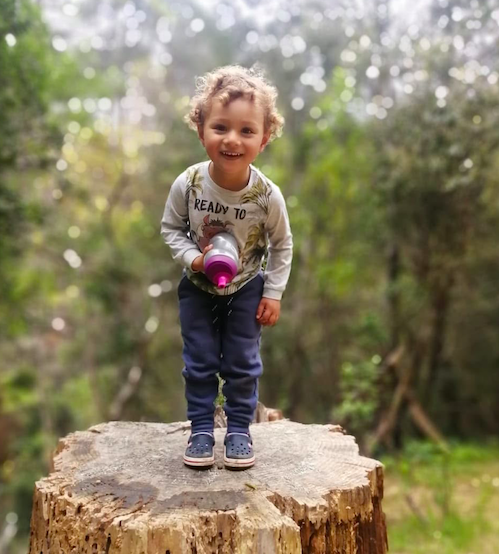
On Friday, 29 July 2022, only a few days before Elijah’s third birthday, his mother, Courtney Cottle, took him to the hospital with a persistent cough. He was held overnight for observation. When it looked like he was recovering, he was discharged.
However, that Sunday, Elijah was walking strangely. He refused to put weight on his right leg. Back at the hospital, he was diagnosed with synovitis and sent home with anti-inflammatories and pain killers. There was no improvement. In fact, he got worse.
By Tuesday, Elijah wasn’t walking at all and in the early hours of Wednesday morning, his fever spiked. He was rushed to the Vincent Pallotti emergency room. When the doctors scanned for synovitis, there was no evidence of it. So, the hunt for the cause started. It was a race against time as the paralysis spread.
It is every parent’s worst nightmare. Your child is deadly sick. Yet no one, not even the experts, could tell you what was wrong.
“You don’t know what’s going on. You’ve got a three-year-old who celebrated his birthday in hospital and can’t use his legs. You’ve got another baby at home. It was very hectic,” Dino shares.
Courtney adds: “It was just over a week, and no one could give us an actual diagnosis. We didn’t quite understand or know what to prepare for. From the morning to the evening, the goal post just kept changing.”
By the Wednesday afternoon, a paediatric neurologist Dr Sherika Raga was called in. She could narrow it down to two potential causes, but for a definitive diagnosis, they needed to do an MRI with Elijah fully sedated. So, Elijah was transferred to Chris Barnard at two in the morning on Thursday.
The family was encouraged to go home, to rest, but Dino refused. He slept on the hospital floor to stay with his son. This moment would become the birth of Elijah’s social media journey. Dino’s first post was a love letter from father to son; a promise to stay by his side. Later, the page would grow to inform, educate, advocate and encourage others.
Of the decision to stay over, Dino shares: “It’s just what you would do as a parent. You would sleep on the floor for your kid.”
While the lack of a diagnosis and the pace at which Elijah’s health was declining was a true horror, Dino and Courtney battled with their inability to communicate with their son who was so very young. Dino shares: “Elijah started speaking very late. You’re trying to ask your son what’s wrong and he can’t even explain it.”
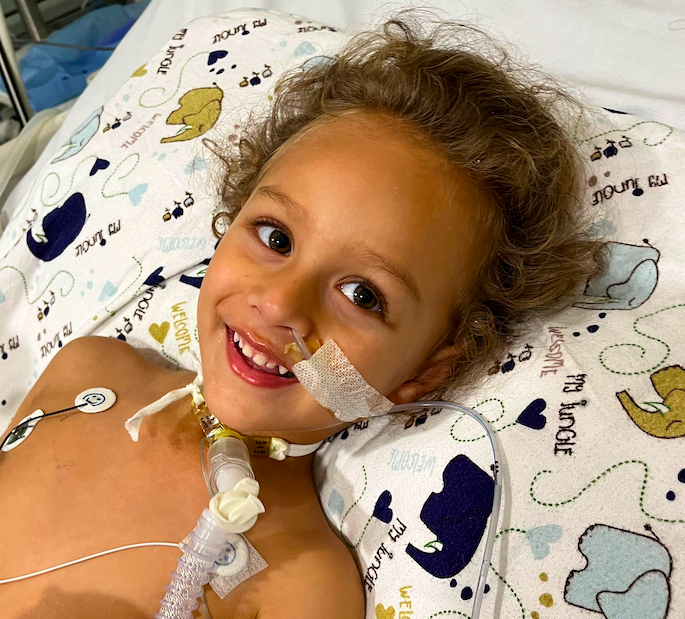
At Chris Barnard, Elijah was prepared and sedated, a terrifying experience for a parent. Dino recalls seeing his three-year- old son unconscious and connected to all the machinery: “I think seeing him with all the tubes and the pipes just broke me.”
Life-changing diagnosis
On 4 August 2022, less than a week after falling ill, Elijah was diagnosed with Acute Flaccid Myelitis (AFM), a rare neurological condition that attacks the spinal cord to cause sudden weakness. About one person in every million is affected. The majority are children. The severity and lasting impact of the condition depends on the individual. There is no cure, and the symptoms need to be managed. Less than 10 percent of people with AFM recover completely.
At the initial diagnosis, Elijah’s future was uncertain. Partially because the condition differs from person to person, but mostly because it is so rare. The medical staff were learning about the disease with the Cottle family, which made any predictions difficult.
“He was knocking on death’s door at that point. The paralysis had moved up to his diaphragm,” Courtney recalls. “His lungs kept filling up with mucus. They had to keep taking him into surgery to suck out all the mucus because it wasn’t draining on its own. Essentially, he was drowning. It was a touch and go.”
Slowly, Elijah started to recover a bit. There was some relief that he wouldn’t die, but his future was still uncertain. The doctors predicted that Elijah would have to be hospitalised for eight months and require a ventilator for the rest of his life.
“It’s very difficult when you don’t have any experience with someone who’s paralysed. Your mind is quite narrow on what paralysis means,” Courtney shares.
“There’s the knock-on effect with everything else from your colon to your bladder to your lungs to circulation to muscle deterioration. Okay, he’s not going to die, but he’s going to go home with a home ventilator. He’s going to be on that for life. You’re now having to learn how to clean out a tracheostomy, change it every day, monitor a machine,” she reflects.
Small wins
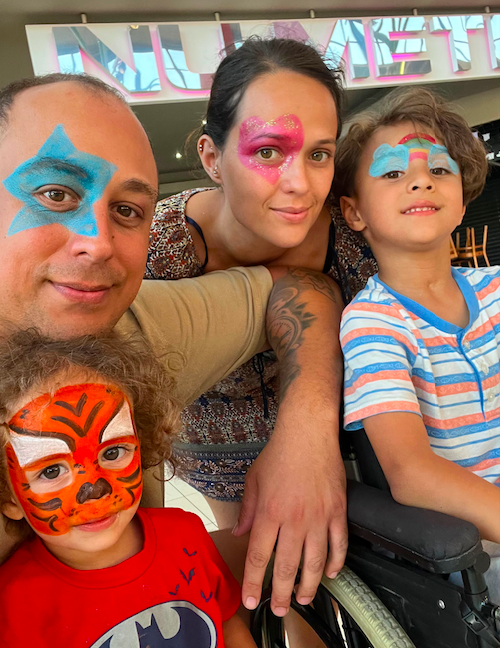
From Elijah’s initial diagnosis, the Cottles have been counting their small wins. The first was that the family was so quick to bring Elijah in when he started getting worse.
“When we went into hospital and checked him, they said that if we had kept him at home that night, he would have died in his sleep. So, that is a win, the first win,” Courtney shares.
The second win would come a week before Elijah was discharged. He recovered much sooner than expected and could go home after only six weeks. More good news awaited the family.
“There were talks of him being sent home with a home ventilator. We applied for it, and it was approved. Everything was done. Then a week before he got discharged, we met with a nurse who was going to teach us how to clean everything,” Dino shares. “She told us that Elijah’s lungs had healed completely, and he won’t need the ventilator. We take that as a win. Every small thing we take as a massive win.”
There would be many more wins for the family born from their determination to give Elijah the best possible chance of walking again … and they were going to try everything.
Persistent pursuit
While researching the condition, Dino came across a plastic surgeon who performed nerve transfer surgeries on children with AFM. Dr Amy Moore has successfully restored some function for these children. The challenge? She was based in Columbus, Ohio. In the United States (US).
Dino started reaching out. He phoned. He sent e-mail after e-mail. He reached out on Instagram, Facebook and even started an X (formerly Twitter) account to get in touch. For three months, he kept trying.
“I thank my persistent sales nature,” Dino shares. His efforts paid off when Dr Moore set up an online consultation. That was the third big win.
The next win came when Elijah qualified for the surgery. It was imperative that there was still some nerve function in his lower body for Dr Moore to transfer nerves. Elijah had retained sensation in his legs and complete functionality of his right foot. This is where they would take the nerves.
Qualifying for the surgery turned out to be the easiest part. Affording the surgery was the true battle. The initial bill for the surgery was US$ 64 000, roughly R1 million today. To add further pressure, the family was on the clock.
The surgery had to take place within a year of the initial diagnosis. They had already lost many months trying to contact Dr Moore.
The fifth big win during this time came when the hospital revised the original quote. They called it a clerical error; the Cottles called it a miracle. The new quote was roughly US$ 20 000 (roughly R330 000 today). It was still an enormous task, but more manageable. The cost of the operation was crowdfunded while all the additional costs like travel and accommodation was covered by the family. Elijah was going to get his surgery.
Nerves of steel
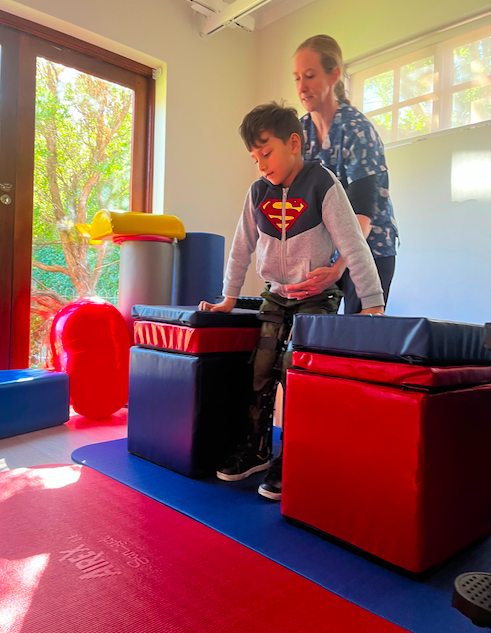
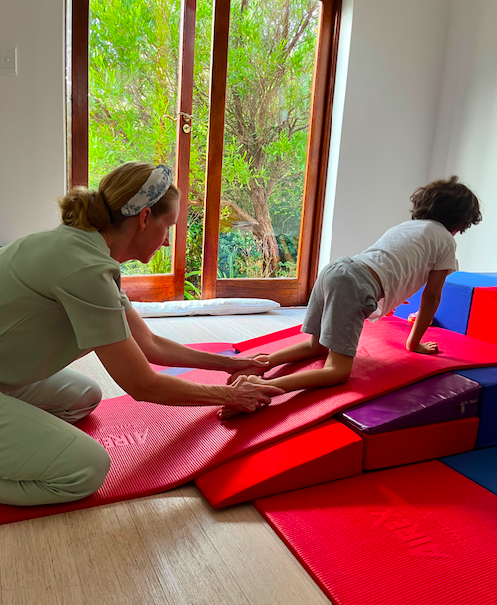
In June of 2023, almost an entire year after his diagnosis, Elijah was due for his nerve transfer surgery. Dino had travelled to Ohio with his son while Courtney stayed home with Elijah’s younger brother, Isaiah.
Dr Moore moved the nerves from Elijah’s foot to his glutes and quads. The surgery was a success. Now, when Elijah tells his brain to move his toes, it moves his legs. Dr Moore also removed scar tissue that was blocking the signals from the brain to his lower limb. This also helped greatly to restore some function.
Videos of Elijah pre- and post-transfer truly show the incredible difference the operation made. He has more function in his hands and can now crawl on all fours. The family is hoping that over time, as the nerves regenerate, they will see even more improvement.
Following the surgery, Elijah was encouraged to go for intensive rehabilitation to ensure the best possible recovery. This would mean another six months in America.
“Our visa only allows us six months at a time because we have a tourist visa to the US. But we were going to give this boy the best chance,” Dino shares. So, Courtney and Isaiah joined Dino and Elijah in America, and they moved to family in Texas where Elijah received the best possible rehabilitation.
The sacrifices and hard work were all to give Elijah the best chance of success … but the fight was far from over. The next big obstacle was the endless advocacy that comes with disability.
Hunting for inclusion
When the Cottle family returned in January 2024, they immediately started searching for schools. As AFM only affected Elijah’s mobility, it was recommended that he try and get into a mainstream public school.
This proved to be a great challenge. They contacted nearly 20 schools all of which immediately turned them down. Two were promising. The first was too expensive for the family, while the second finally declined the family after numerous interviews.
“Unfortunately, they made the decision not to go ahead because once he gets to grade three, all the classes are located upstairs,” Dino shares. It seemed the school hadn’t thought to move the classes for one year.
After nearly a year without any luck, a family friend suggested Pinelands North, which turned out to be a perfect fit for Elijah. The school had previously welcomed children in wheelchairs and currently had children with autism. More importantly, the school had the correct attitude around inclusion.
“One of their missions or ethos of the school, that I love, is that they don’t make the child around the school; they create the school around the child, which was so beautiful to hear after struggling with all those other schools,” Dino reflects.
By this time, mid-2025, Elijah should have already started school. Despite missing the first half of the year, the school suggested throwing Elijah into the deep end to see how well he does. While he fared pretty well, he has missed a lot more than just six months of school. Since the age of three, Elijah had been in and out of hospitals. He has missed out on many of the fundamentals.
In the end, Elijah was held back to give him the best possible chance to succeed in his schooling. While a difficult choice, the family is just happy to have Elijah in school and socialising with his peers.
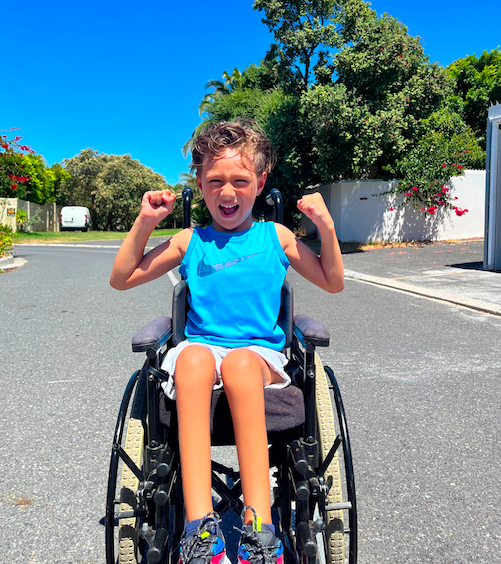
“Seeing him interact with the kids, it’s beautiful as a parent. It’s inclusion. They don’t leave him out, which is beautiful to see. He’s actually made solid friendships for the first time. All he knew from the age of three was hospitals, doctors, physiotherapists and routine,” Dino reflects.
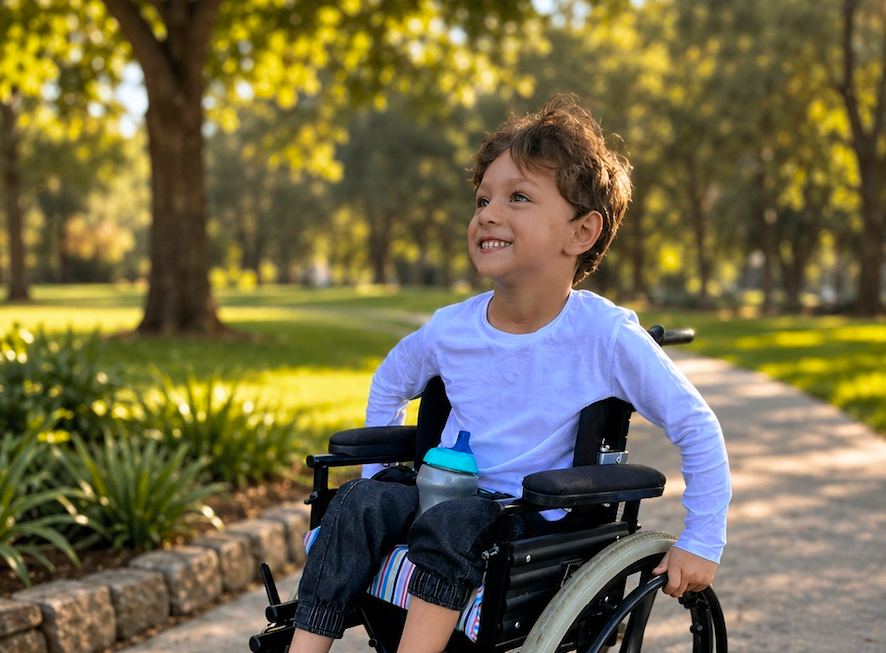
“They learned in such a short space of time that yes, he has a wheelchair, and yes, his situation is a little bit different, but that doesn’t mean he is different. He’s still a six-year-old at the end of the day. He still wants to play. If kids can learn that in such a short space of time, why can’t adults? Why do we lose that the older that we get?” Courtney questions.
The Cottles dream of a world that is much easier for children with disabilities to navigate, starting with better access to mainstream schooling. Dino believes that parents should be able to enrol their children in a school of their choosing, and the school should be responsible for accommodating the child.
Courtney notes the impact inclusion can have on the greater society. Elijah’s friends will grow into adults who are comfortable with and understand disabilities. They may even become employers who encourage more diverse workforces.
Inclusive play
The Cottles are now on a journey to see the same inclusion in playgrounds. There are very few playgrounds in South Africa with any accessible features for children with disabilities. Even when there are adapted equipment, it feels removed or like an afterthought. Especially, when compared to the inclusive playgrounds that the Cottles visited in the US. This mission became particularly important as Elijah’s brother grew into an active, playful child.
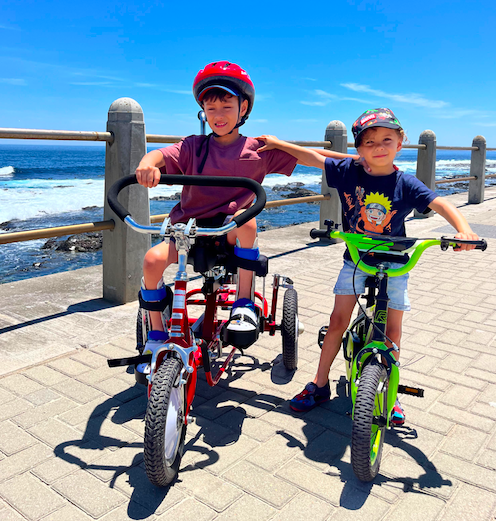
“Elijah loves Green Point Park, but he can’t play on anything. With his brother being so wild, Isaiah run out of the jungle gym and Elijah just sits in his wheelchair at the bottom. It breaks my heart,” Dino shares. Any attempt to get Elijah involved has been met with push back from the security at the park.
“We’ve had arguments with the security. Adults are not allowed on their equipment. I get that is the rule, but my child is paralysed. He wants to come down the slide. He can’t reach the top, so I need to carry him up. Now, you’re threatening to kick us out. You’re making a difficult life even more difficult. You’ve got this heavy heart all the time. You just want him to play,” Courtney shares.
From schools to playgrounds, excluding children with disabilities can harm them. Courtney explains: “My child is not his wheelchair. He’s a whole person. He has an identity and being paralysed isn’t who he is. It just happens to be something that has happened to him.”
“If you’re teaching him at this age to limit himself because able-bodied people’s minds are closed off, then what kind of world are we going to put him in when he’s an adult? If I’m telling him “No” from six years old, how long is it going to take until he stops pushing himself?” she questions. Dino dreams of one day building a fully accessible playground in his son’s name. For this, the family needs a lot more support … especially financially.
Battling bills
Disability comes with an endless need for advocacy, but also endless bills. From wheelchairs that Elijah will outgrow to therapy and medical complications, the bills have been endless for the family.
“It’s very expensive. When he was just diagnosed, the medical aid covered all of his physiotherapy. A minimal amount was out of pocket,” Courtney shares. “Over the years, it’s been just cut and cut and cut. Now, for example, we can only do one therapist who gets covered by medical aid.”
The family is covering a big portion of Elijah’s medical bills out of pocket. They are also covering the salary for the facilitator at the school (a requirement of the school), and the complications that are arising from his condition. Elijah’s spine is starting to curve as he favours his stronger, right side. He might need a brace or surgery. The greatest heartbreak for the Cottles is that money is the true obstacle in Elijah’s recovery.
“The only thing that’s preventing Elijah from having the best chance at walking again is money. I would love to be in a position where I could send him to physiotherapy three days a week. I know there are kids out there who are doing it five days a week,” Dino shares.
Courtney echoes his sentiment: “We’re in a very unique situation. It’s not cerebral palsy, spina bifida or a spinal cord injury where his outcome is definitive. He could walk again. That chance is very much there. We don’t know how far he will go in the future. So, the financial issue is directly impacting us.”
While both Dino and Courtney are working, their combined income isn’t enough to cover all the medical expenses, therapies and two growing boys. They have relied heavily on crowdfunding for support, but this has become a challenge as there is a constant need for more … and they aren’t going to deny their son important medical care.
“We’re not going to refuse to take him to the doctor because we can’t afford it right now. You can rather give me a bill and add interest. I’m going to give him what he needs at that time. We’re running fundraisers all the time, but all that money is going directly to the child,” she adds. The family isn’t able to get ahead of their expenses, or really catch a moment’s break, which is a big strain on both Dino and Courtney.
Burying it for later
Over the past four years, the family has faced endless battles with very little time to process. Dino and Courtney had to put their emotions to the side to focus on the financial battles.
“You have to put all your trauma in a little box and throw it in the back of your mind because you’ve got financial problems to worry about first. You can’t even process what’s happening to your child because you’ve got all these other things happening first,” Courtney reflects.
While they try and stay positive for Elijah, it is hard, as Dino shares: “It’s difficult, especially with the weight of the world on your shoulders. As men, we’ve been taught from a young age to internalise everything. It’s tough because I’ve got to deal with expectations from work. I have targets to achieve. I have a family to provide for. I have kids that I’m teaching about morals and values. I’m trying to raise gentlemen here.”
While Dino and Courtney will continue to fight to provide for Elijah, so that he may never wonder if they could have done more, the family does call on their community for support.
“Advocacy is hard. It’s hard to have a job, make enough money, cover all his therapies, take him to school, be a person, be a mom and then advocate on top of that. It shouldn’t always just fall onto the parents. It should fall onto the community,” she shares.
“Biologically, he’s our child, but he is also everyone else’s child. We are one nation, one community. We should all be working together for the betterment of everyone. We don’t know what his potential is, and what he could offer the world. If you’re limiting him, we’re also losing out on everything,” she adds.
A little push
The Cottles aren’t waiting for inclusion or accessibility to catch up. They are slowly instilling a resilient mindset in their son by pushing him to give his best. Their motto: Practice makes progress.
For Dino, it is important to encourage Elijah to always give his all, even if that is just 20 minutes. Whether through encouragement or through example, it is clear that Elijah has adopted his parent’s resilience.
He continues to work hard and inspire others. You can follow along with Elijah’s story on Facebook or Instagram.