You can need help with almost everything and still be completely in charge of your life
By Brittany McCormick
When most people hear the word independence, they picture someone doing things alone. Cooking their own meals. Getting dressed without assistance. Driving themselves somewhere. Working. Living alone. Moving through the world without needing anyone else.
For many people with disabilities that definition creates an impossible standard. What happens when your body genuinely requires assistance? Does needing help mean you are less independent? Does needing someone to help you get dressed mean you have less control over your life?
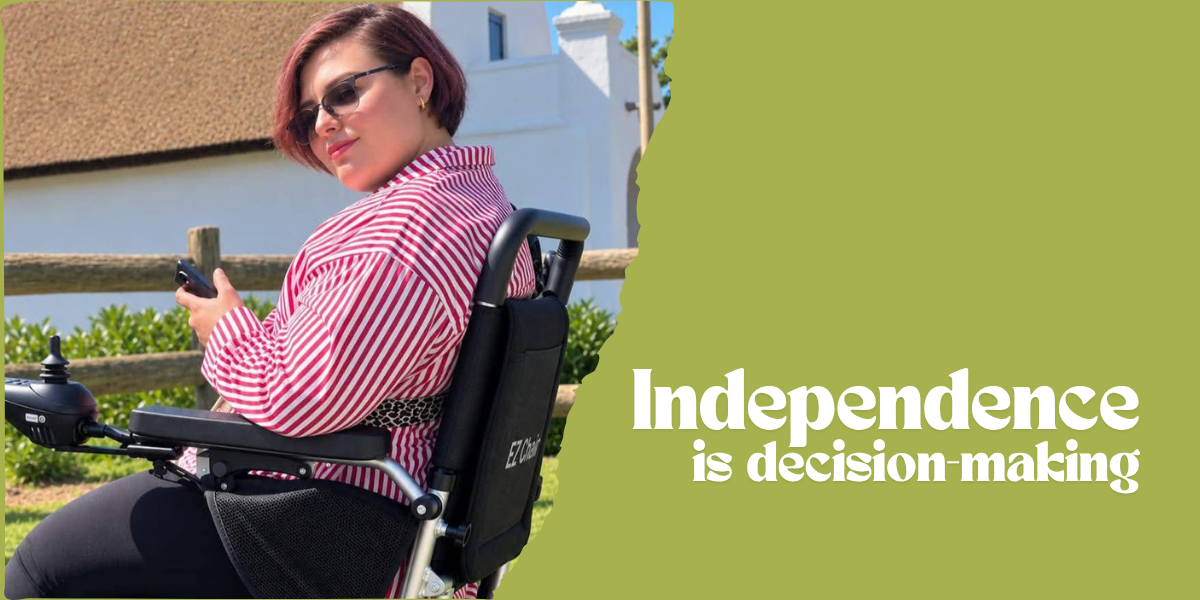
No. And perhaps that is because we have misunderstood what independence actually means. Independence is not the absence of help. Independence is the presence of choice.
A person can require assistance with almost every physical task and still be completely in charge of their own life. They can need someone to help them dress, but choose what they wear. They can need someone to prepare their food, but decide what they want to eat. They can need someone to drive them, but choose where they are going.
They can need assistance with their body while remaining the person who makes decisions about their life. That distinction is important.
Ed Roberts, one of the pioneers of the Independent Living movement, required an iron lung to breathe. His life challenged the assumption that physical dependence automatically meant personal dependence. His argued that “independent living is a psychological idea much more than a physical concept”.
The point was never that people with disabilities should somehow prove they could live without assistance. The point was that assistance should not mean surrendering control.
The question we should be asking
When we talk about disability and independence, perhaps we are asking the wrong question. Instead of asking, “What can this person do without help?”, we should ask, “Who is making the decisions?”.
That question reaches much deeper. When someone helps a disabled person get dressed, who decides what they wear? When someone cooks for them, who chooses the meal? When someone drives them somewhere, who chooses the destination?
When a healthcare professional explains treatment options, is the person being given the information and space to make an informed decision? Or has the decision quietly been made for them?
From the outside, these situations can look exactly the same. Someone is helping. Yet, there is a profound difference between being helped and having your life directed for you.
Help can support independence. It can also unintentionally replace it.
Sometimes control disappears quietly
This does not always happen because someone is controlling or cruel. Often, it happens because people care.
A parent steps in because they do not want their child to struggle. A caregiver does something because it is quicker. A family member makes a decision because they believe they know what is best. A healthcare system focuses on getting things done rather than teaching someone how to participate in decisions about their own life.
Sometimes the world is simply designed in a way that makes it easier for someone else to decide. None of this necessarily comes from bad intentions. But good intentions do not automatically make a decision yours.
When decisions are repeatedly made on someone’s behalf, something can happen over time. They may stop being asked. They may stop expressing what they want. They may become accustomed to accepting whatever has already been decided.
Eventually, they may begin to believe that independence means doing everything alone rather than having a voice in the life they are living.
Independence is also a responsibility
Independence is not simply about demanding that other people listen to you. It also involves learning to listen to yourself. Learning what your body needs. Learning when you are tired. Learning when you need rest.
Learning what foods make you feel better and which ones do not. Learning to cook when you have the opportunity. Learning to ask questions at medical appointments. Learning to understand your own needs.
Learning to communicate when something is wrong. Learning when you can safely do something yourself. And learning when asking for help is the responsible choice.
These are forms of independence too. Sometimes society talks about independence as though it begins when you stop needing people. But perhaps real independence is much more complicated.
Sometimes independence means saying: “I can do this myself.” Sometimes it means saying: “I need help with this.”
Both can be decisions. The difference is whether the decision belongs to you.
It is never too late to learn
One of the most uncomfortable truths about independence is that decision-making is a skill. And skills require practice. Some people with disabilities grow up with opportunities to make decisions about their own lives.
Others do not. Some are protected so heavily that they rarely get the chance to make mistakes. Some have families who make decisions because they are trying to help.
Some encounter systems that make choices on their behalf. Some simply reach adulthood without ever being asked enough: What do you want?
That question can become surprisingly difficult. Especially when you have spent years adapting to what other people can provide. But difficulty answering the question does not mean you have no desires.
Sometimes it simply means you have not been given enough opportunities to practise listening to yourself.
That is why it is never too late. Thirty is not too late. Forty is not too late. Fifty is not too late. There is no age at which a person becomes too old to start making more intentional decisions about their own life.
You can learn to cook at thirty; learn to understand your body; learn to set boundaries; learn to speak up; ask for the help; say no; say yes. Independence does not have an expiration date.
Choice requires options
We cannot talk honestly about independence without talking about access. It is easy to tell someone to “make their own choices” when the world has given them choices to begin with. What happens when accessible housing is unavailable? What happens when transport is inaccessible? What happens when financial circumstances limit someone’s options?
A choice only has meaning when there are genuine options. That is why independence cannot be placed entirely on the individual. Sometimes the barrier is not a person’s willingness. Sometimes the barrier is the environment around them.
We should not tell people to simply “take control” of lives in which society has deliberately or unintentionally removed many of their choices.
Independence is not a competition
There is also no prize for needing the least amount of help. A wheelchair user does not become more worthy because they can transfer without assistance. A person who needs a caregiver does not become less capable because they need that support.
Someone who requires help every morning is not somehow failing at adulthood. And asking for help is not the opposite of independence.
Sometimes, asking for help is independence. Independence was never supposed to be a performance for the comfort of people who do not understand disability. Small decisions build a life
We often imagine independence as one enormous moment. Managing everything without assistance. But independence is rarely built in one dramatic moment.
It is built through ordinary decisions. Thousands of small decisions eventually become a life.
And perhaps true independence begins not when you stop needing people, but when you stop believing that needing people means you have to disappear inside the help they provide.