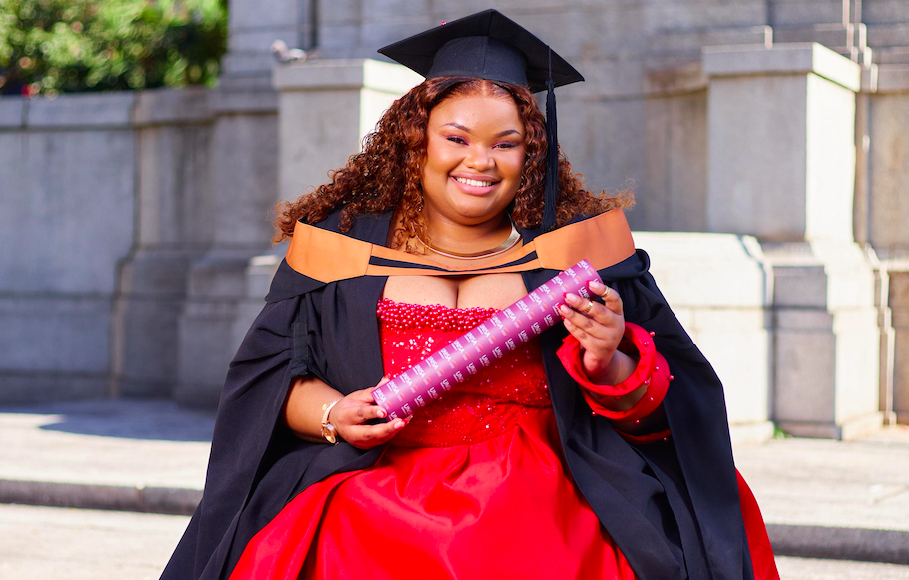
With some support from QASA, Nelisiwe is building the greatest version of herself and working towards her dreams
Diagnosed at age five with Congenital Kyphoscoliosis, Nelisiwe Sibiya has been a wheelchair user all her life. It is the only life she has ever known. She shares: “Adapting came naturally, especially since I was surrounded by a supportive family who never made me feel different.”
The comfort she feels in her own skin is most evident in the confidence she radiates. She is bright, bubbly and full of life – savouring all the beauty that life has to hold.
“I just believe life is too short to constantly worry about things we can’t change. Any chance you get to be happy, grab it with both hands and wheel with it. Everyone deserves a ray of sunshine, because when the storms come, that light will help you make it through,” she shares.
With such an optimistic nature and outlook on life, it is hard to imagine that Nelisiwe struggles with her own anxieties and short comings, which held her back … at least until recently.
In 2024, Nelisiwe graduated from the QuadPara Association of South Africa (QASA) Work Readiness Programme. Life hasn’t been the same for her since.
“At the time, I was stuck in a cycle of learnerships without finding stable employment. The programme equipped me with valuable skills for the workplace and, as a result, I am now permanently employed at QASA,” she shares.
The programme included a work experience element, which Nelisiwe completed with QASA. The organisation was so happy with her performance that she was offered a permanent position as office administrator.
The programme also included life coaching with Len Davey from The World Within. Her work with Len helped Nelisiwe overcome some of her anxieties and short comings so that she can step into her potential.
“The life coaching sessions played a big role in helping me navigate the workplace, especially when it comes to managing emotions and overcoming fears,” she says.
“Before life coaching, I really struggled with procrastination. As much as I had the drive and passion to act on things, I’d constantly delay tasks until the very last minute. I also had poor time management and often found myself overwhelmed because I wasn’t planning properly.”
“Another big challenge was being too hard on myself, setting high standards and then beating myself up when I didn’t meet them exactly,” she adds.
“But my biggest struggle was making phone calls, even personal ones. The idea of talking to someone without seeing their face or expressions made me extremely anxious. It felt like a conversation without connection, and that really unsettled me,” she shares.
The life coaching assisted her to address these challenges. She reflects: “I won’t say I’m 100 percent over the anxiety, but I no longer panic when the phone rings. I’ve learned how to stay calm throughout calls, even the difficult ones.” Beyond helping her overcome her anxieties, life coaching brought more structure to her life.
“It taught me how to manage my time better, stop procrastinating, and break down tasks into realistic steps. I’ve also learned to be kinder to myself and to see challenges as growth opportunities rather than failures,” Nelisiwe says.
“Life coaching didn’t just help me fix what I was struggling with, it empowered me to take control of my life and stay focused on the purpose that drives me,” she shares.
These skills have helped her take a step closer to her goal by pursuing a degree in criminology, which she obtained this year.
“I’ve always believed that real change starts with understanding the root of our societal issues and criminology allows exactly that. Growing up with a disability has given me a unique lens on justice, inequality, and how systems can either support or fail people,” she explains.
“I wanted to study criminology because I’ve seen how vulnerable communities, including persons with disabilities, are often overlooked in conversations about crime and justice,” Nelisiwe says.
“Studying criminology empowers me to challenge those gaps and be part of creating safer, fairer communities. For me, criminology isn’t just a field of study, it’s a tool to help make the world more just, compassionate and accessible for everyone,” she adds.
Her ultimate goal is to work in the criminal justice system or the forensic field and advocate for fair treatment of marginalised groups like people with disabilities, women and children.
“I hope to use my career to be a voice for the voiceless and a bridge between justice and humanity,” Nelisiwe says. “I see myself using my knowledge and experience to influence policy, raise awareness, and contribute to more inclusive justice systems.”
“Whether it’s through research, advocacy, or community-based programmes, I want to be part of solutions that prevent crime, support rehabilitation, and promote dignity for all,” she adds.
She is planning to continue her studies with an honours degree in Forensic Science and Technology with hopes of securing a bursary.
“That support would mean everything to me, not just financially, but as a step closer to achieving my dream of using forensic science to create safer, more inclusive communities. I’m committed to growing, learning and using my education to drive real change,” she notes.
As Nelisiwe grows more into her confidence and pursues the life of her dreams, she encourages others to do the same.
“Honestly, you don’t realise how much you need life coaching until you start doing it. It’s been a powerful shift in my personal and professional life. It helps you unlock a version of yourself you didn’t even know existed,” she says.
“It’s not about someone telling you what to do. It’s about being guided to find your own clarity, confidence and purpose,” she continues.
“It gave me the tools to take consistent action toward my goals. Sometimes, we get stuck not because we’re lazy or unmotivated, but because we don’t know how to move forward, and that’s where life coaching comes in,” Nelisiwe explains.
“It’s a safe space to grow, reflect, and shift your mindset. If you’re serious about becoming your best self and living with intention, I honestly believe life coaching is one of the best investments you can make in yourself,” she adds.
Nelisiwe encourages others to be brave, step out and make themselves heard. She shares: “Your disability does not define who you are. Don’t be afraid to step out and make your voice heard. Use your experience to build a greater version of yourself.”
“If you don’t, you may miss the chance to meet the person you’ve been searching for in all the wrong places, only to realise that version has been within you all along, just waiting for permission to shine,” she adds.
Since Nelisiwe and her cohort graduated, QASA has altered its Work Readiness Programme to focus specifically on life coaching to build confidence, positive self- perceptions and healthy coping mechanisms so that members can thrive in their professional careers. QASA members can enquire about the programme at info@qasa.co.za or you can reach out directly to Len for more information at len@theworldwithin.co.za.